Coupang Global Selling vs Korea Stock for Foreign Sellers
Short answer: Coupang Global Selling lets you sell to Korean shoppers from abroad without a Korean company. It suits products that clear customs as personal parcels. Food and supplements need extra paperwork, and chilled goods usually need stock in Korea.
Most guides present Coupang Global Selling as the easy way into Korea. It is easy to join. The harder question is whether your product can legally and practically travel to a Korean shopper as a personal parcel.
This guide covers what the program is, what it costs, how each order clears Korean customs, and which products are better imported and stocked in Korea. It ends with simple rules for choosing a route for each product.
What is Coupang Global Selling?
It is Coupang’s program for sellers outside Korea. You list on Coupang, ship each order from abroad, and get paid in your own bank account, with no Korean company required.
According to Coupang’s Global Selling page, you need neither Korean language skills nor a Korean business entity, and sign-up is free. Coupang says the marketplace reaches more than 20 million active customers. The seller portal runs in Korean, English, and Chinese.

To register, Coupang’s seller FAQ lists four documents: a business license, proof of identity, proof of business ownership, and a bank statement. Approval usually takes up to five business days when the documents are complete.
Fulfillment depends on where you are based. The same FAQ still lists Coupang’s FBA-style service for sellers in China only, but Coupang now runs similar routes for Japan and the US. In August 2026 Coupang also announced Coupang Global Fulfillment for sellers in Japan.
For sellers in the US, Coupang Global Services describes storage and fulfillment to Korea from Coupang’s centers in California. It also offers a wholesale (1P) route, where Coupang buys your products, stores them, and handles fulfillment. Sellers elsewhere ship cross-border parcels or use a logistics partner.
How much does Coupang Global Selling cost sellers?
There is no sign-up fee. You pay a sales commission by category, a 3% fee on the shipping charge you set, and a monthly service fee once sales pass ₩1 million.
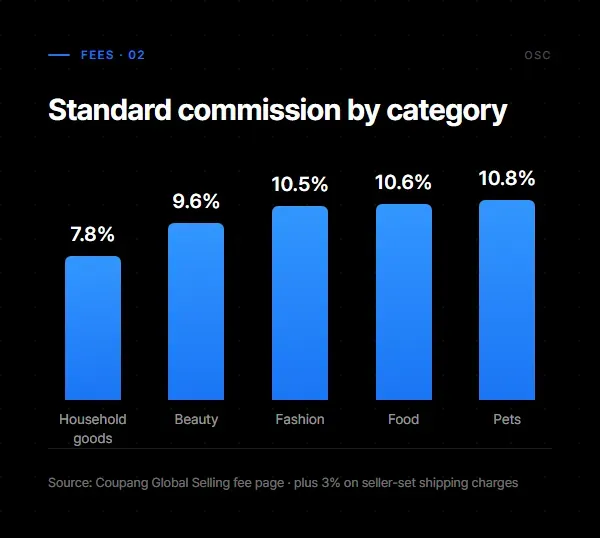
Coupang’s fee page lists commission rates by category. A few standard rates are below. Detailed sub-categories can differ, so check yours when you list.
| Category | Standard commission |
|---|---|
| Food | 10.60% |
| Beauty | 9.60% |
| Household goods | 7.80% |
| Fashion | 10.50% |
| Pets and pet supplies | 10.80% |
Payouts follow Coupang’s settlement guide. You are paid once a month by transfer to an overseas bank account, on the 15th business day of the following month. Under the same guide, if monthly sales stay under ₩1 million, the amount rolls into the next month.
Above ₩1 million in monthly sales, the guide says Coupang charges a ₩50,000 monthly service fee. For appliances, computers, and electronics, that fee starts above ₩5 million. In your first months, model these thresholds before you price, not after.
How does a Global Selling order clear Korean customs?
Each order enters Korea as a personal import in the shopper’s name. Small personal parcels can clear on an invoice, but the shopper’s customs code is required and some categories are excluded.

Under the Korea Customs Service express cargo rules, goods for personal use up to US$150 can clear on an invoice alone. The limit is US$200 for goods shipped from the US. The owner’s resident registration number or personal customs clearance code must be provided.
Under the same rules, between that limit and US$2,000, the parcel goes through a simplified import declaration. Above US$2,000, it needs a general import declaration. That can mean duties and VAT for your shopper, so your price point matters as much as your product.
What this means for you: plan your hero product’s price against the US$150 limit, or US$200 if you ship from the US. Then decide whether a bundle that crosses the line is worth the extra friction.
Which products struggle with cross-border selling to Korea?
Products the customs rules exclude from invoice clearance, such as foods, health supplements, and quarantine goods, plus chilled items and anything that needs a Korean label to sell well.
The Korea Customs Service excludes several groups from invoice-only clearance. The list includes drugs, medicinal herbs, wild animal products, and agricultural, fishery, and livestock goods subject to quarantine.

It also covers health supplements, foods, alcoholic beverages, tobacco, and certain cosmetics, such as those containing placenta or steroids. If your product sits in one of these groups, each parcel faces more paperwork.
Food has a second layer. The MFDS imported food safety page says food imported for sale or business needs an import declaration. MFDS also inspects food that Koreans buy through overseas direct purchase.
Shoppers also read the package. Under MFDS food labeling rules, a product sold in Korea carries its name, ingredients, dates, net contents, business details, nutrition, and storage instructions. A package printed only in English or Japanese asks the shopper to trust what they cannot read.
When should you hold stock in Korea instead?
When your product is food, a supplement, or chilled, or when you need a Korean label and fast local delivery to compete. Then an importer brings the stock in first.
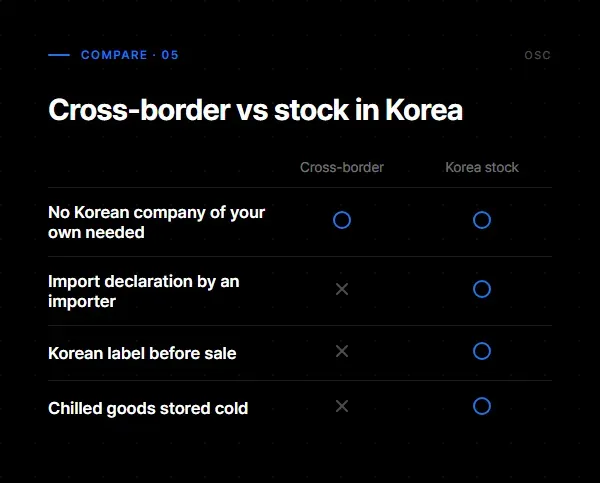
Holding stock in Korea changes who does what. A Korean importer files the import declaration, attaches the Korean label, and stores the goods.
Sales then run from inventory that has already cleared customs. Korea’s e-commerce law also requires mail-order businesses to register, under Article 12 of the E-commerce Consumer Protection Act.
| Global Selling (cross-border) | Stock in Korea | |
|---|---|---|
| Korean company | Not required | Needed, yours or an importer’s |
| Customs | Each parcel, in the shopper’s name | By the importer, through an import declaration |
| Korean label | Optional for the listing | Attached before sale |
| Chilled goods | Hard to ship per order | Stored cold in Korea |
| Delivery to shopper | International transit | Domestic delivery |
In our own work, a Japanese natto brand we imported shows the switch. The product was chilled, its package was in Japanese only, and it had no Korean importer or sales history.
We imported it as the importer, attached a Korean import-food label, kept it refrigerated, and opened a Coupang store. At one point, it reached first place in Coupang’s natto category.
How do you choose between the two routes?
Decide product by product. Check the customs exclusions, the price limit, storage needs, and whether shoppers need a Korean label. You can run both routes at once.
Use these rules in order for each product:

- If your category is on the customs exclusion list, such as health supplements or quarantine goods, plan for an importer and stock in Korea.
- If the product needs refrigeration, plan for stock in Korea. Per-order international shipping is a poor fit for chilled food.
- If your typical order is above US$150 (US$200 from the US), expect shoppers to face a fuller declaration. Test a smaller bundle on Global Selling first.
- If shoppers need Korean text to choose your product, such as ingredients, allergens, or usage, the Korean label is part of the product. That points to importing.
- If none of the above applies, Coupang Global Selling is a low-cost way to test demand before you commit stock. In the US, CGF from California is a middle route.
What this means for you: list your top five products and mark each one against these five rules today. Products that pass every rule can start on Global Selling. The rest need a plan to sell on Coupang from stock in Korea, which is the route we cover on our sell on Coupang page.
FAQ
Do I need a Korean company to use Coupang Global Selling?
No. Coupang says Global Selling needs no Korean business entity or Korean language. You register with your own business license, proof of identity, proof of ownership, and a bank statement.
How long does Coupang take to approve a global seller?
Usually up to five business days. Coupang’s FAQ gives that time when all four documents are submitted correctly.
When does Coupang pay global sellers?
Once a month. Under Coupang’s settlement guide, Coupang pays on the 15th business day of the following month. It pays by transfer to your overseas bank account, once monthly sales pass ₩1 million.
Can I sell health supplements through Coupang Global Selling?
It depends on the product. The Korea Customs Service excludes health supplements from invoice-only clearance, so each parcel needs more paperwork. Plan for that, or import the product and sell from stock in Korea.
What is the duty-free limit for Global Selling orders?
Under the Korea Customs Service rules, the limit is usually US$150. Goods shipped from the US can clear on an invoice up to US$200. Food and supplements cannot clear on an invoice. Under the same rules, they go through an import declaration, where the duty-free limit is US$150 including shipping.
Sources
Some images in this article were generated with AI.
- Coupang’s Global Selling page — https://globalsellers.coupang.com/en/
- Coupang’s seller FAQ — https://globalsellers.coupang.com/en/faq/
- Coupang Global Fulfillment for sellers in Japan — https://globalsellers.coupang.com/en/newsroom/coupang-global-fulfillment-cgf-officially-launches-in-japan/
- Coupang Global Services — https://www.coupangglobalservices.com/
- a sales commission by category — https://globalsellers.coupang.com/en/how-much-does-selling-on-coupang-cost/
- Coupang’s settlement guide — https://globalsellers.coupang.com/en/seller-university/coupang-settlement/
- Korea Customs Service express cargo rules — https://www.customs.go.kr/english/cm/cntnts/cntntsView.do?mi=8057&cntntsId=2733
- MFDS imported food safety page — https://www.mfds.go.kr/eng/wpge/m_11/de011002l001.do
- MFDS food labeling rules — https://www.mfds.go.kr/eng/wpge/m_14/denofile.do
- Article 12 of the E-commerce Consumer Protection Act — https://www.law.go.kr/법령/전자상거래등에서의소비자보호에관한법률/제12조