Korean Importer or Distributor: How Foreign Brands Choose

Short answer: Food or cosmetics sold in Korea need a Korean importer registered for that category, such as an Article 15 registration for imported food. The real choice is the route: an importer of record, a distributor, or your own company.
Why does a foreign brand need a Korean importer?
Because Korean law makes a registered Korean business answer for imported food and cosmetics: it files the declaration, holds the category registration, and puts its name on the label.

Under the Customs Act, Article 242, import declarations are filed in the name of the goods’ owner or a licensed customs broker. For food, the Special Act on Imported Food Safety Control goes further. A business that imports food for sale must register with the Minister of Food and Drug Safety (Articles 14 and 15) and file its import declaration there (Article 20).
Cosmetics follow the same logic. The Cosmetics Act requires a business that distributes or sells cosmetics, imported ones included, to register as a responsible cosmetic distribution business and employ a responsible distribution manager (Article 3). In practice, a Korean business, yours or a partner’s, holds these roles.
So the question is not whether you need a Korean importer. It is which kind, and on what terms.
Should you use an importer of record, a distributor, or your own company?
It depends on how much control you want over price, stock, and listings, and how much you are ready to invest in Korea. A distributor takes the most work off you; your own company keeps the most control.
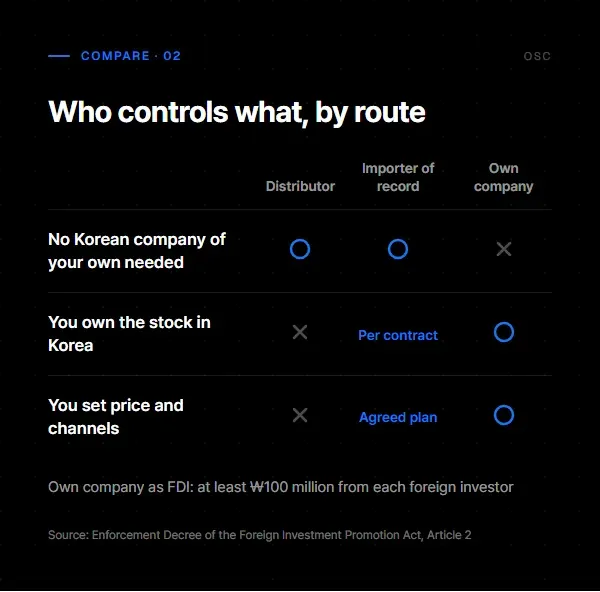
| Route | Korean company of your own? | Who usually owns stock in Korea | Who sets price and channels | What you set up first |
|---|---|---|---|---|
| Distributor | No | The distributor, which buys from you | Mostly the distributor | Find one that wants your category, agree volumes and territory |
| Importer of record that also sells | No | Depends on the contract | A plan agreed with you | Korean labels, registrations in the importer’s name, store pages |
| Your own Korean company | Yes | You | You | The company and its investment (FDI under FIPA starts at ₩100 million per investor), then your own registrations and staff |
A distributor buys your stock and takes it from there. That is simple for you, but price, channels, and how your brand appears become mostly the distributor’s decisions. Ask whether it wants exclusive rights, for which channels, and for how long.
An importer of record imports in its own name and holds the registrations. Some only clear customs and hand the goods to whoever you name; others also run the stores. Whether the importer takes ownership of the goods depends on the contract. If it does, the stock is no longer yours to move when you change partners.
Your own Korean company gives full control and full cost. To count as foreign direct investment under the Foreign Investment Promotion Act (FIPA), the Enforcement Decree, Article 2, requires at least ₩100 million from each foreign investor. The investor must also hold at least 10% of the voting shares or appoint an executive, as Invest Korea summarizes. After that, you still need the category registrations, staff, and a team that runs Korean stores.
Shipping single orders from abroad to Korean shoppers is a separate route. Korean food law treats those as goods individuals buy directly for personal use (Article 2). An online purchase agency for imported food registers as its own business type (Article 14). This guide does not cover that route.
Which registrations must the importer hold for your product?
It depends on the category, because one general import registration in Korea does not cover food, cosmetics, health functional foods, and electrical goods. Match the registration to your exact product before anything ships.

- Food and health supplements: an imported food import-and-sale business registration with the Minister of Food and Drug Safety (Articles 14 and 15). The overseas factory must also be registered before the import declaration is filed (Article 5). That registration is valid for two years and can be extended, so put the expiry date in your shipping calendar.
- Health functional foods: the business that sells them also reports a sales business to the local government under the Health Functional Foods Act, Article 6.
- Cosmetics: registration as a responsible cosmetic distribution business, with a responsible distribution manager (Cosmetics Act, Article 3). Functional cosmetics, such as whitening, anti-wrinkle, or sun-protection products, need a ministry examination or a report before sale (Article 4). The ingredient list is reported before the product is distributed or sold (Article 5).
- Electrical appliances and some consumer products: some products are on the safety certification list. For those, the manufacturer or the importer certifies each model under the Electrical Appliances and Consumer Products Safety Control Act, Article 5. The Act issues certification per model, so ask how each of your models will be covered.
- Selling online: the business that sells to consumers by mail order files a report under the Act on the Consumer Protection in Electronic Commerce, Article 12. It then shows that report number to buyers (Article 13).
Inspections belong in the timeline too. Under Article 21 of the imported food law, the ministry inspects food before customs clearance and can vary the inspection by the product’s inspection history. A first shipment has no history yet, so do not plan the launch around the fastest case.
Ask which of these the importer holds in its own name, for your exact category. A food registration does not cover cosmetics, because they are separate registrations under separate laws.
What happens to labels and listings if you change importers?
You may need new labels and new store listings, because the Korean label names the business and the sales history stays with the selling account. Plan the exit before you sign.

Three things are tied to the importer or the seller, not to your brand:
- The Korean label. Food labels must show the name and location of the place of business (Act on Labeling and Advertising of Foods, Article 4). Cosmetics labels carry the business operator’s trade name and address in Korean (Cosmetics Act, Articles 10 and 12). A new importer means new labels on new stock.
- The store listings. If the importer sells from its own Coupang or Naver account, the reviews and sales history sit on that account. The same product can perform differently from one account to another. In our own operation on Coupang, listing the same product on a different account does not bring its purchase score with it or improve its ad efficiency by itself. So decide whose account the listing lives on before it goes up, not at the exit.
- Stock already in Korea. If a distributor bought it, it is theirs to sell. If you still own it, the contract should say how and when it moves to the next partner.
None of this is a reason to avoid an importer. It is a reason to write the exit into the contract on day one.
How do you check a Korean importer before you sign?
Run five checks in this order: registration, factory or model certificates, a draft label, an ownership list, and a plan in weeks. Each one asks for a document, not a promise.
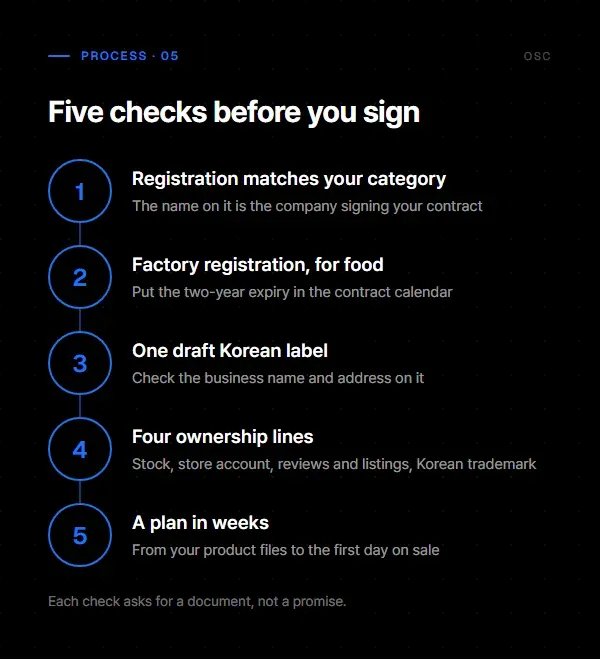
- Match the registration to your category. Ask for the certificate that applies: food import-and-sale registration, cosmetics responsible distribution registration, or the mail-order report. Check that the business name on it is the company signing your contract.
- For food, confirm the factory registration before the first shipment. Write the two-year expiry date into the contract calendar and agree who files the extension.
- Get one draft label first. Ask for a Korean label for one product before you ship anything. Check the business name and address on it, because that is the company the label ties you to.
- Write four ownership lines. Stock, the store account, reviews and listings, and the Korean trademark if you file one. One line each in the contract, including what happens at the end.
- Ask for the plan in weeks. It should run from receiving your product files to the first day on sale, with the label, store pages, and extra documents as separate steps. At the listing step, check the category, option setup, and search filters. In our listing work, these are three settings we commonly find wrong on new listings.
Questions to ask any Korean importer
Use these with every importer you talk to, including us.

- “Which registrations do you hold in your own name, and does each one cover my category?” A clear answer names the registration, the law, and the category.
- “Who owns the stock after customs clearance, and who sets the retail price?” The answer tells you whether you are talking to a distributor or to an importer that sells for you.
- “Whose name is the store account in, and what happens to it if we end the contract?” A partner who has been asked before has the answer ready, labels and stock included.
FAQ
Can a foreign company import directly into Korea without a Korean importer?
Not for food or cosmetics sold to consumers. The Customs Act lets the owner of the goods file the declaration, but selling those categories requires a Korean business registered for them. Without your own Korean company, you work through an importer of record or a distributor.
What is the difference between a Korean importer and a Korean distributor?
A distributor usually buys your stock and decides price and channels. An importer of record imports in its own name and, in a sales arrangement, sells under a plan agreed with you. Who owns the stock depends on the contract, so ask.
Do I need my own Korean company to sell in Korea?
No. An importer of record can hold the registrations. Your own company makes sense when the volume justifies its staff and registrations; to count as foreign direct investment under FIPA, each foreign investor must put in at least ₩100 million.
Does one importer registration cover food and cosmetics?
No. Food needs the import-and-sale business registration under the imported food law, and cosmetics need a separate responsible distribution registration under the Cosmetics Act.
How long does it take to start selling through a Korean importer?
It depends on the category and on the registrations the importer already holds. The Korean label and store pages come first, and categories with extra documents or a closer inspection take longer. Ask for the plan in weeks before you sign.
Related reading
- Korean E-commerce in 2026: Market Size, Platforms, and Rules
- Marketing in Korea: Strategies for Foreign Brands in 2026
How does OSC work as a Korean importer?
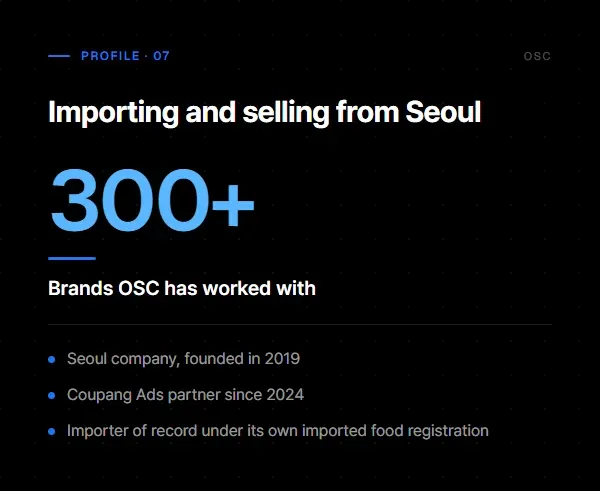
OSC is a Seoul company, founded in 2019, that has worked with more than 300 brands and has been a Coupang Ads partner since 2024. It imports as the importer of record under its own imported food import-and-sale registration and mail-order sales registration.
In our sales agency model, products sell on OSC’s Coupang account, because ad efficiency for the same product differs from account to account. Moving a product to a fresh account does not carry its purchase score over. Brands that need the account in their own name choose store operation instead. For details, see our importer of record Korea page.
Some images in this article were generated with AI.
Sources
- Customs Act (Korea), Article 242 — https://www.ktc.go.kr/en/pageLink.do?link=%2Fcontents%2Fen%2FEG25110
- Special Act on Imported Food Safety Control, Articles 2, 5, 14, 15, 20 and 21 — https://elaw.klri.re.kr/eng_mobile/viewer.do?hseq=63626&type=part&key=36
- Cosmetics Act (Korea), Articles 3, 4, 5, 10 and 12 — https://www.law.go.kr/LSW/eng/engLsInfoR.do?lsiSeq=270323
- Act on Labeling and Advertising of Foods, Article 4 — https://elaw.klri.re.kr/eng_mobile/viewer.do?hseq=68803&type=part&key=36
- Electrical Appliances and Consumer Products Safety Control Act, Article 5 — https://elaw.klri.re.kr/eng_mobile/viewer.do?hseq=61394&type=sogan&key=13
- Act on the Consumer Protection in Electronic Commerce, Articles 12 and 13 — https://elaw.klri.re.kr/eng_mobile/viewer.do?hseq=68473&type=part&key=28
- Health Functional Foods Act, Article 6 — https://elaw.klri.re.kr/eng_mobile/viewer.do?hseq=57453&type=part&key=36
- Enforcement Decree of the Foreign Investment Promotion Act, Article 2 — https://elaw.klri.re.kr/eng_mobile/viewer.do?hseq=44628&type=sogan&key=13
- Invest Korea, Definition of Foreign Direct Investment — https://www.investkorea.org/ik-en/cntnts/i-333/web.do