Korean E-commerce in 2026: Market Size, Platforms, and Rules
Short answer: Korean e-commerce reached about ₩272.0 trillion in 2025, and 77.6% of it was bought on phones. A foreign brand reaches Korean shoppers mainly through two search boxes, Coupang and Naver, and needs a legal import route first.
How big is Korean e-commerce in 2026?
Korean online shopping reached ₩272.0 trillion in 2025, up 4.9%, with ₩211.1 trillion of it bought on mobile, according to preliminary full-year official figures.

Those numbers come from the Ministry of Data and Statistics online shopping survey for December 2025 and the full year. The ministry is the former Statistics Korea, and it marks the 2025 figures as preliminary. Mobile purchases made up 77.6% of the total. Growth is slowing: the same release shows 7.1% in 2024 and 4.9% in 2025.
Two categories matter for consumer brands. In the same survey, online food and beverage sales grew 9.5% to ₩37.8 trillion, and cosmetics grew 7.7% to ₩13.8 trillion. Both outgrew the market as a whole.
You will also read that Korean e-commerce is “roughly half” of retail, as the International Trade Administration country guide to Korean e-commerce puts it. The official survey gives a narrower number: online sales of goods were 28.2% of retail sales in 2025.
The two figures are not built the same way. The official goods share leaves out travel, food delivery, e-coupons, and other services, which likely explains part of the gap. If you sell physical products, plan with the 28.2% figure.
What this means for you: the market is large and mature, so you are not early. Shoppers already have habits, favorite apps, and very fast delivery. Your product has to fit those habits, not teach new ones.
Which Korean e-commerce platforms matter for a foreign brand?
Coupang and Naver are the two names to know first: Coupang is the leading shopping app, and Naver is the search engine where shoppers compare products. Category stores and open marketplaces fit later, once the product has reviews.
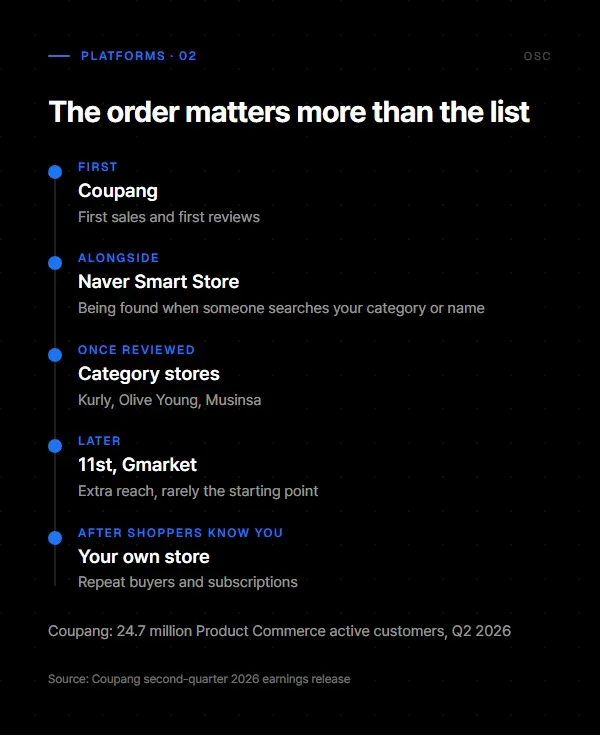
The International Trade Administration guide names Coupang the leading platform for both mobile and desktop users. Coupang reported 24.7 million Product Commerce active customers in Coupang’s second-quarter 2026 earnings release. That counts everyone who ordered at least once in the quarter. Naver is Korea’s main search engine, and products from its Smart Store sellers appear inside Naver search results.
Payment runs through the same ecosystems. The same guide notes that Naver Pay and Kakao Pay are widely built into shopping apps. It also reports that Kakao and Naver hold about half of the digital payments market.
| Platform | What shoppers use it for | Role for a new foreign brand |
|---|---|---|
| Coupang | Fast delivery (Rocket Delivery), price, reviews | First sales and first reviews |
| Naver Smart Store | Search, comparison, brand discovery | Being found when someone searches your category or name |
| Category stores: Kurly (premium food), Olive Young (health and beauty), Musinsa (fashion) | Shoppers who already know what they want in one category | Once the product has reviews and a brand name people search |
| 11st, Gmarket | Open marketplaces | Extra reach later, rarely the starting point |
| Your own store | Repeat buyers, subscriptions | After shoppers know the brand |
The order matters more than the list. In our own launches, we build the selling page first and start a review program for its first reviews before we put money into traffic. Bringing in visitors means little if the page cannot turn them into buyers.
One more lesson from the platform list itself. Some older guides still name TMON and WeMakePrice as major sites. Both were hit by the July 2024 seller-settlement delays, and an Energy Economy (EKN) report on the 2025 figures linked last year’s 27.5% drop in e-coupon sales to that crisis. Before you sign with any platform, read when and how it pays you.
How do Korean shoppers choose what to buy online?
Korean consumers tend to research products extensively and rely heavily on reviews and localized content before buying, according to the International Trade Administration guide. A brand they have never heard of has to pass that research.
The step that is easy to miss from abroad is the brand-name search. A shopper who spots your product in a video or a creator’s post can type your brand into Coupang or Naver. If that search returns nothing, a reseller, or a page with no reviews, the interest is wasted.
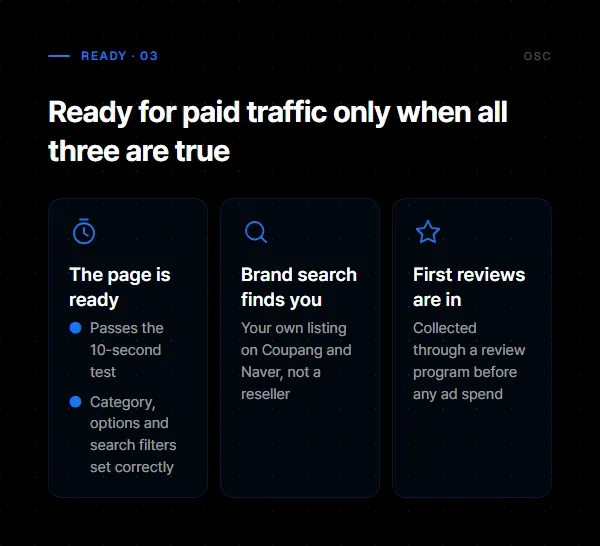
So in our practice the selling side comes before the traffic side. Before we put paid traffic behind a new brand, we look for three things:
- The page passes our 10-second test and has its category, options, and search filters set correctly (both checks are explained in the checklist further down).
- Your brand name returns your own listing on both Coupang and Naver, not a reseller’s.
- The page has its first reviews, collected through a review program before any ad spend.
Short-form video, creators, and ads come after these three, because they send people to a page that now gives them a reason to buy.
If you are a small brand, this order is good news. You do not need a big awareness budget to be found. You need one page that answers the shopper who already typed your name.
Can a foreign brand sell in Korea without a Korean company?
Yes, through two of the three routes. Cross-border selling and a Korean importer of record both work without your own Korean entity. Setting up a Korean company is the third route.
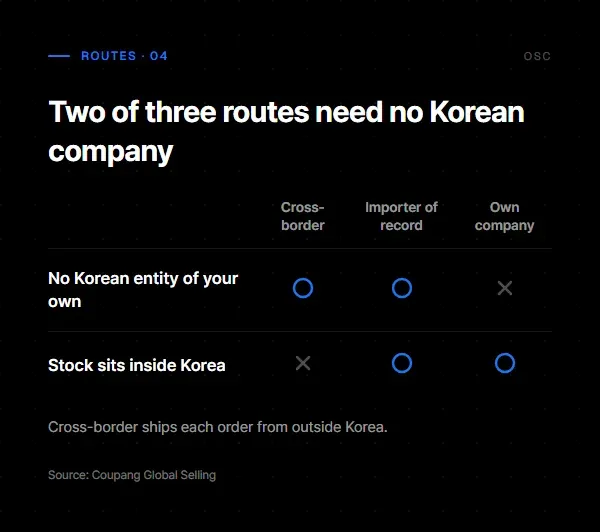
Coupang Global Selling says it needs “no Korean language and Korean business entity.” Each order then ships from outside Korea. The importer route puts your stock in Korea under a Korean company’s registrations, while the brand stays yours.
| Route | Who imports | Where stock sits | Fits when |
|---|---|---|---|
| Cross-border (e.g., Coupang Global Selling) | The shopper, order by order | Outside Korea | You want to test demand with little setup |
| Korean importer of record | A registered Korean company | Inside Korea | You sell food or other regulated goods, or need next-day delivery |
| Your own Korean company | You | Inside Korea | You plan a long-term local team and can handle licenses yourself |
Cross-border is the fastest start, but your delivery date competes with products that arrive tomorrow. For U.S. goods, the International Trade Administration guide notes that express shipments of US$250 or less are duty-free under the KORUS FTA.
If you want the whole route from import to first sale laid out step by step, see how foreign brands sell in Korea with a local importer.
What does a foreign brand need before its first sale?
For stock sold inside Korea, you need a registered importer, Korean labeling, an online-seller report, and inventory that ships domestically. Food is the strictest case, so we use it as the example.
- A registered importer. Under the Special Act on Imported Food Safety Control, Article 15 requires an import food business to register with the Ministry of Food and Drug Safety (MFDS). Article 20 requires an import declaration for each shipment.
- Responsibility. The same Article 20 makes the declarant responsible for the safety and quality of the imported food. That is why the importer’s name on the declaration matters.
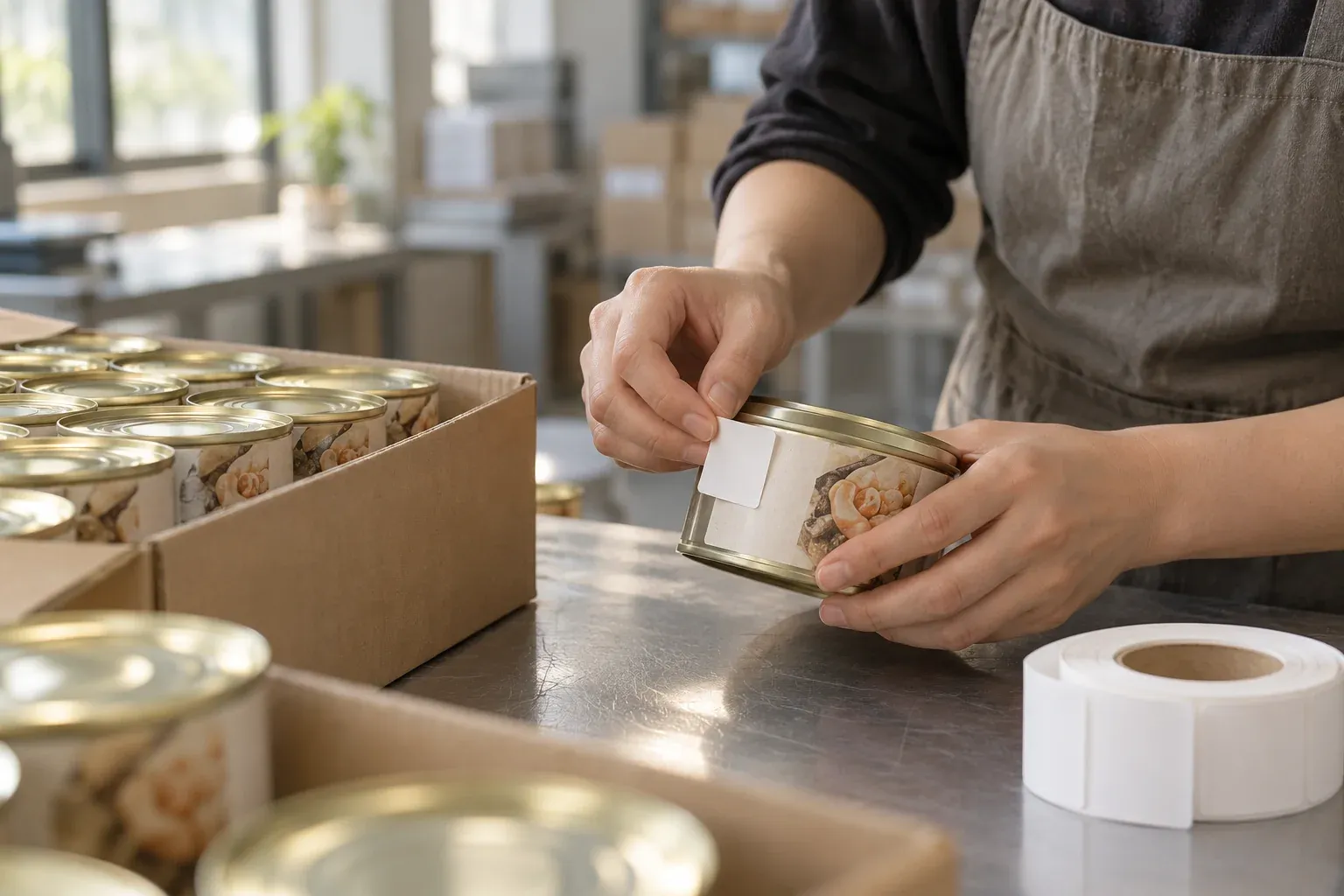
- Korean labels. The MFDS Food Labeling Standards, in the version in force since August 29, 2025, set a rule for imported food that is already sold in the exporting country. Such food must carry the exporting country’s own labeling and may add a Korean-printed sticker. The sticker must stay firmly attached and must not cover the original product name or date marks.
- An online-seller report. Article 12 of the Act on Consumer Protection in Electronic Commerce requires mail-order businesses to report their details to the Fair Trade Commission or local government.
- A stock decision. Look at the delivery dates on the top 10 products from your category search (check 1 below). If most of them arrive the next day, hold stock in Korea; if many ship from abroad too, cross-border is enough to start.
Cosmetics, supplements, and electronics follow their own rules. Ask your importer which registrations cover your category before you print anything.
What should you check on Coupang and Naver this week?
Five checks you can do yourself in an afternoon, before you talk to any partner. Each one tells you something different about your starting position.
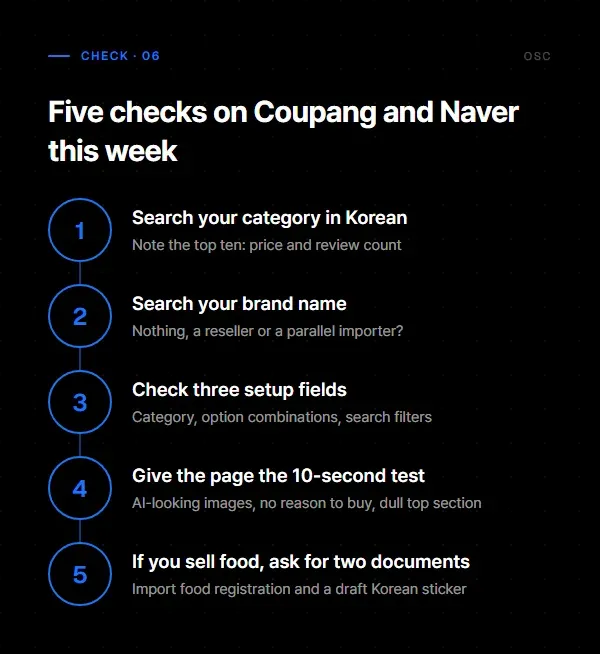
- Search your category in Korean on both platforms. Use the word a Korean shopper would type, and write down the first 10 products, their prices, and their review counts. If all 10 are Korean brands with large review counts, plan a review program from day one.
- Search your brand name on both. Note what comes up: nothing, a reseller, or a parallel importer selling your product. If someone else already sells it, settle who owns the listing before launch, because shoppers will compare prices.
- Check three setup fields on any page that sells you. These are three setup mistakes we commonly see on new listings: the wrong category, option combinations nobody checked, and search filters left blank or filled in wrong. Each one hides the product from buyers.
- Give the product page the 10-second test. When we look at a new page for 10 seconds, three signals predict trouble: images that look AI-generated, no clear reason to buy, and a dull top section. Fix any of the three before paying for traffic.
- If you sell food, ask for two documents. Ask the importer for its import food business registration, and for a draft of the Korean sticker. Approve the sticker before the goods ship, not after they land.
What have we learned running brands on Coupang?
The account a product sells on changes its results, and reaching the top of a category is easier than staying there. Both come from running several Coupang accounts at the same time and comparing the same product across them.

The account matters, not just the product. On Coupang, how much ad budget an account can use, and how efficiently, differs by account, so the same product on two accounts performs differently. That is why, in our sales agency model, the product sells on OSC’s account. Brands that need the account in their own name can choose store operation instead.
Moving the same product to another account does not reset it. Brands sometimes expect a fresh account to bring a fresh start, but it does not automatically raise purchase scores or improve ad efficiency. A new listing strategy, with a different category, options, or search terms, can help. The account switch alone does not.
Getting to the top is easier than holding it. One Japanese natto brand we work with reached first place in Coupang’s natto category, and a good promotion can lift a product in the rankings. Holding the position takes reviews, a clear reason to choose you, and more people searching your brand by name. In our experience, that last number is the clearest difference between brands that keep growing and brands that stall.
Questions to ask any Korea partner
Whoever you talk to, including us, these three questions show how a partner actually works. The answers are worth writing down.

- “Whose name is on the import declaration, and who owns the stock?” Under Article 20 of the Special Act, the declarant answers for safety and quality. Ask whether you keep ownership of the goods once they are in Korea.
- “Which account will sell my product, and what happens to it if we stop working together?” Some models sell on the partner’s account, some on yours. Both can work, but you should know which one you are signing.
- “Will you track the share of my sales that comes from people searching my brand name, and report it to me?” Brand searches come from people who already want you. A partner who tracks that share is watching whether your brand grows, not only whether this month’s sales do.
FAQ
Is Korean e-commerce still growing?
Yes, but more slowly. Official figures show online shopping grew 7.1% in 2024 and, on preliminary data, 4.9% in 2025, reaching about ₩272.0 trillion. Food and cosmetics grew faster than the total.
What is the biggest Korean e-commerce company?
The International Trade Administration’s country guide names Coupang the leading platform for both mobile and desktop users. Coupang reported 24.7 million Product Commerce active customers in the second quarter of 2026. Naver is the other giant, because its search engine shows Smart Store products directly in results.
Can a foreign company sell on Coupang?
Yes. Coupang Global Selling lets a foreign company list without a Korean entity, shipping each order from abroad. To sell from stock inside Korea, a foreign brand works through a Korean importer or sets up a Korean company.
Should I sell cross-border or hold stock in Korea?
Start cross-border if you want to test demand with little setup. Move stock into Korea once most of the top products in your category arrive the next day, because your delivery date then competes with theirs.
How do Korean shoppers find a brand they have never heard of?
Korean shoppers tend to research products and rely heavily on reviews before buying, according to the International Trade Administration. A shopper who spots your brand in a video can look it up on Coupang or Naver, so that search should show your own page with reviews.
Related reading
- Marketing in Korea: Strategies for Foreign Brands in 2026
- Korean Importer or Distributor: How Foreign Brands Choose
Some images in this article were generated with AI.
Sources
- Ministry of Data and Statistics (formerly Statistics Korea), “December 2025 and annual online shopping trends” (February 2, 2026) — https://mods.go.kr/board.es?act=view&bid=241&list_no=443337&mainXml=Y&mid=a10301010000
- Coupang, Inc., “Coupang Announces Results for Second Quarter 2026” (August 4, 2026), SEC Form 8-K Exhibit 99.1 — https://www.sec.gov/Archives/edgar/data/0001834584/000183458426000070/cpng-06302026ex991.htm
- Coupang Global Selling — https://globalsellers.coupang.com/en/
- Special Act on Imported Food Safety Control, Articles 15 and 20 — https://www.law.go.kr/LSW/lsInfoP.do?lsiSeq=285337
- Act on Consumer Protection in Electronic Commerce, Article 12 — https://www.law.go.kr/LSW/lsInfoP.do?lsiSeq=282793
- MFDS Food Labeling Standards (식품등의 표시기준), MFDS Notice No. 2025-60, in force since August 29, 2025 — https://www.law.go.kr/admRulInfoP.do?admRulSeq=2100000263558
- International Trade Administration (trade.gov), country commercial guide “South Korea - eCommerce” — https://www.trade.gov/country-commercial-guides/south-korea-ecommerce
- Energy Economy (EKN), report on 2025 online shopping figures (February 2, 2026) — https://m.ekn.kr/view.php?key=20260202022244994